

Are we finally witnessing the death of the hipster headdress?
Cartoon can be found on http://adverbemonade.tumblr.com, and check out how many people have re-blogged it!
Earlier: But Why Can't I Wear a Hipster Headdress?
(Thanks Scott!)

This Indian Brave Mascot Costume gives a boost to your school spirit. Shindigz is your place to find the fiercest and most affordable mascot costumes.Fierce AND affordable.
Morton, a longtime Stilwell resident, said he appreciated the opinion of everyone in attendance, especially the students, but the school might need to teach more Cherokee concepts to the children.Many of the attendees who were against the mascot were not happy with the vote, and will likely keep fighting for its removal or a "compromise" that would allow the students to keep the mascot, if it were a less stereotypical and offensive image.
“Naturally, it is a student project and students are very protective of their projects, as well as they should be,” he said. “Perhaps a more in-depth understanding of Cherokee culture, Cherokee life ways and Cherokee history would cause a person not to want Tommy Tomahawk to represent them as a people.”
“I’m from this community, and I’ve got a lot of calls from Native Americans in this district and they’ve certainly been offended,” he said. “I think we could’ve done a better job with what we picked. I think we made him look awful ugly.”The problem with a "better" representation is that research has shown even "positive" or "neutral" images (think Disney's Pocahontas) of American Indians cause reductions in self esteem and self worth for Native students--even if they report "positive associations" with the mascots.
Four studies examined the consequences of American Indian mascots and otherThe entire article can be read online here, and I highly recommend it.
prevalent representations of American Indians on aspects of the self-concept for American Indian students. When exposed to Chief Wahoo, Chief Illinwek, Pocahontas, or other common American Indian images, American Indian students generated positive associations, but reported depressed state self-esteem, and community worth, and fewer achievement-related possible selves. We suggest that American Indian mascots are harmful because they remind American Indians of the limited ways others see them and, in this way, constrain how they can see themselves.
 (image via www.cherokeephoenix.org)
“It was done strictly to create school spirit because they’re proud of their Indian heritage,” Fletcher said. “Primarily, it was something the kids got after and promoted. Even our Indian heritage club was part of (the) promotion of that and donated funds for that.”That (alarming and maddening) statement from a school official reminded me of this great cartoon that manages to capture so much:
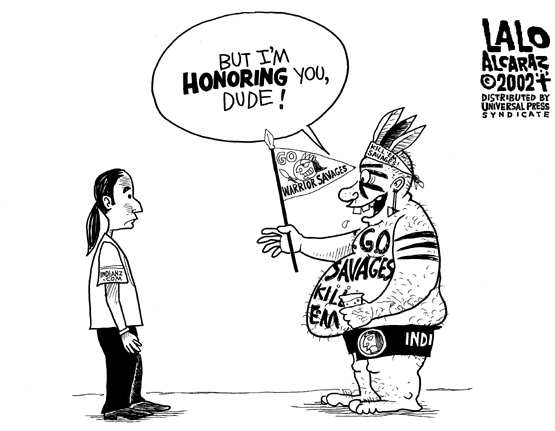 (image via http://www.bluecorncomics.com/stharm.htm)
CN citizen and Stilwell alumna Melanie Knight said she was disappointed the school would create a mascot that is a caricature and warped image of American Indians.The mascot follows the pattern of most other Indian mascots--his clothing reflects a "plains" style, though not a correct representation of any tribal dress, he has the stereotypical long braids and face paint, and, of course, he is styled to look menacing.
“It has been difficult to address long-term mascots that have become part of some schools’ history and legacy,” she said. “This is an opportunity to prevent that from happening. Tommy Tomahawk and his personification clearly says to me that Indians are a joke.”
 (image via http://www.berrybeadwork.com/)


